



- Dit evenement is voorbij.
Witnessing the onset of reionization through Lyman-α emission at redshift 13 – publication
Using the unique infrared sensitivity of NASA’s James Webb Space Telescope, researchers can examine ancient galaxies to probe secrets of the early universe.
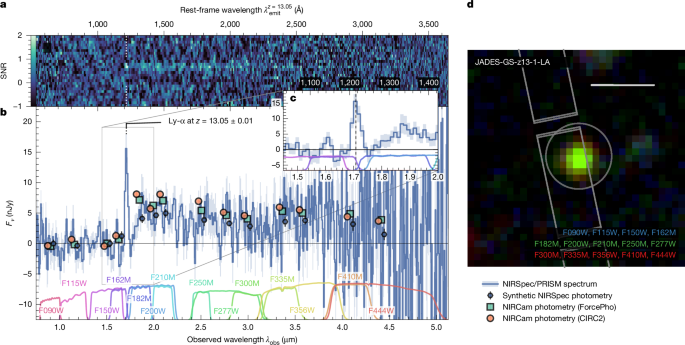
An international team of astronomers has identified bright hydrogen emission from a galaxy in an unexpectedly early time in the universe’s history. The surprise finding is challenging researchers to explain how this light could have pierced the thick fog of neutral hydrogen that filled space at that time. The Webb telescope discovered the incredibly distant galaxy JADES-GS-z13-1, observed to exist just 330 million years after the big bang, in images taken by Webb’s NIRCam (Near-Infrared Camera) as part of the James Webb Space Telescope Advanced Deep Extragalactic Survey (JADES). Researchers used the galaxy’s brightness in different infrared filters to estimate its redshift, which measures a galaxy’s distance from Earth based on how its light has been stretched out during its journey through expanding space. The NIRCam imaging yielded an initial redshift estimate of 12.9. Seeking to confirm its extreme redshift, an international team lead by Joris Witstok of the University of Cambridge in the United Kingdom, as well as the Cosmic Dawn Center and the University of Copenhagen in Denmark, then observed the galaxy using Webb’s Near-Infrared Spectrograph instrument. In the resulting spectrum, the redshift was confirmed to be 13.0.
This equates to a galaxy seen just 330 million years after the big bang, a small fraction of the universe’s present age of 13.8 billion years old. But an unexpected feature stood out as well: one specific, distinctly bright wavelength of light, known as Lyman-alpha emission, radiated by hydrogen atoms. This emission was far stronger than astronomers thought possible at this early stage in the universe’s development. Before and during the era of reionization, the immense amounts of neutral hydrogen fog surrounding galaxies blocked any energetic ultraviolet light they emitted, much like the filtering effect of colored glass. Until enough stars had formed and were able to ionize the hydrogen gas, no such light — including Lyman-alpha emission — could escape from these fledgling galaxies to reach Earth. The confirmation of Lyman-alpha radiation from this galaxy, therefore, has great implications for our understanding of the early universe. The source of the Lyman-alpha radiation from this galaxy is not yet known, but it may include the first light from the earliest generation of stars to form in the universe. A powerful active galactic nucleus, driven by one of the first supermassive black holes, is another possibility identified by the team.
Links:
NASA’s Webb Sees Galaxy Mysteriously Clearing Fog of Early Universe