



- Dit evenement is voorbij.
Freedom in the World 2024 – publication
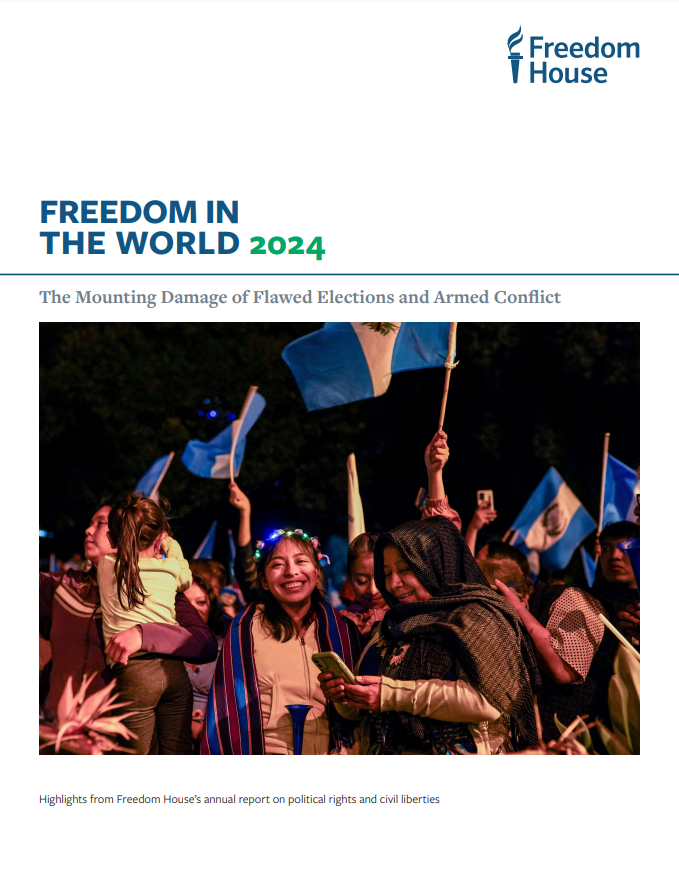
Flawed elections and armed conflict contributed to the 18th year of democratic decline, but by drawing strength from diversity, protecting dissent, and building international coalitions to support their own norms and values, democratic forces can still reverse the long decline in global freedom, according to the report ‘Freedom in the World 2024‘ by Freedom House.
Global freedom declined for the 18th consecutive year in 2023. The scope and scale of deterioration were extensive, affecting one-fifth of the world’s population. Almost everywhere, the downturn in rights was driven by attacks on pluralism—the peaceful coexistence of people with different political ideas, religions, or ethnic identities—that harmed elections and sowed violence. These intensifying assaults on a core feature of democracy reinforce the urgent need to support the groups and individuals, including human rights defenders and journalists, who are on the front lines of the struggle for freedom worldwide.
A total of 52 countries suffered declines over the past year, while only 21 improved. The manipulation of elections was among the leading causes of global erosion in freedom. In Cambodia, Guatemala, Poland, Turkey, and Zimbabwe, incumbents took steps to prevent the political opposition from competing on an even playing field. Leaders in El Salvador and Venezuela bent the rules to ensure their own victories in planned contests. Ecuador’s elections were marred by widespread violence, including the murders of several state officials and political candidates. As a result, that country declined from Free to Partly Free status. Thailand inched up from Not Free to Partly Free thanks to highly competitive national elections, but a military-drafted constitution allowed unelected forces to distort the government-formation process and box out the leading opposition party. Coups continued to obliterate democratic institutions and strip away people’s right to choose their leaders. In July, Niger became the sixth country in the Sahel region of Africa—after Burkina Faso, Chad, Guinea, Mali, and Sudan—to experience a coup since 2020. A military junta ousted the democratically elected government, resulting in an 18-point decline on Freedom in the World’s 100-point scale. Freedoms also continued to deteriorate in Burkina Faso, which suffered two coups in 2022.
Armed conflict over disputed territories unleashed devastating violence and further degraded political rights and civil liberties. Nagorno-Karabakh experienced the most precipitous score decline of the year, losing 40 points after nearly its entire population of 120,000 ethnic Armenians was forced to flee the enclave under intense pressure from Azerbaijan’s military. Hamas’s massive terrorist raid into Israel on October 7 killed some 1,200 people and destroyed Israelis’ sense of safety in their own homes. Israel’s ensuing military campaign in the Gaza Strip, already among the least free places in the world, had resulted in the deaths of an estimated 22,000 people by year’s end, according to Gaza’s Hamas-run health ministry, as well as the internal displacement of 1.9 million others. The global struggle for freedom faces a crucial test in 2024, during which about half of the world’s population will head to the polls and conflicts will continue to rage in Myanmar, Sudan, Ukraine, and elsewhere. Ongoing attacks on pluralism have the potential to fuel voter apathy, further division, and even violence, as they undercut the promise that democracy can deliver for everyone and that diversity of political ideas, belief, and ethnicity is a source of strength. If democracies do not respond to these challenges, more of the world’s people will be denied fundamental freedoms in 2025.
There is still a path toward stronger democracies and greater freedom for all. Recognizing that threats to an election can emerge before, during, and even after the day of voting, democratic governments should redouble their commitment to holding free and fair elections at home and supporting the same abroad. Rigged balloting, military coups, and political or disinformation campaigns that promote exclusion should be quickly and widely condemned. Those who claim or come to power through these means should not be recognized as legitimate leaders. On the international stage, democracies should build broad partnerships based on shared principles, and reaffirm the norms of sovereignty and self-determination that are being subverted by authoritarian aggression from China, Iran, Russia, and others. As it has for decades, the United States can play a vital role in the expansion of global freedom. But much depends on whether the November 2024 presidential election reinforces or weakens America’s democratic values, processes, and institutions, along with its will to uphold the cause of democracy around the world.
Links:
The Mounting Damage of Flawed Elections and Armed Conflict